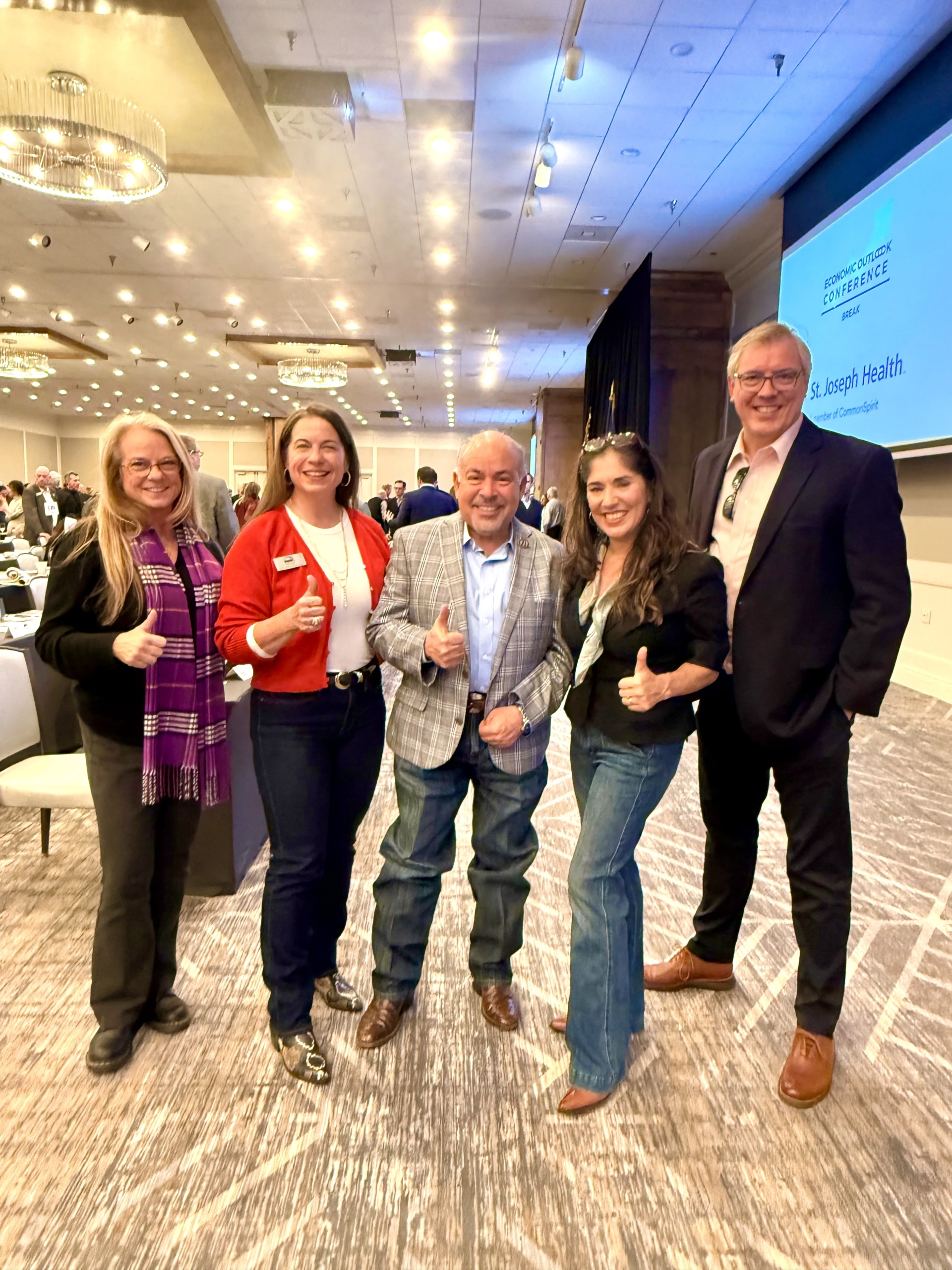
Top 10 Takeaways: 2026 Bryan–College Station Economic Outlook Conference
1. People + Population Growth Remain the Region’s Core Asset
Across city, university, and chamber presentations, the consistent theme was talent attraction and retention. Population growth in both Bryan and College Station continues steadily, driven by Texas A&M, healthcare expansion, and job creation. This underpins long-term housing demand and economic resilience.
2. Texas A&M Is a Global Economic Engine — Not Just a University
TAMU leadership emphasized research commercialization, innovation, and global impact. The message was clear: Texas A&M is driving job creation, spin-off companies, and national visibility, which directly feeds demand for housing, office, and mixed-use development. 3_eoc-tamu-presentation-01-28-26
3. Bryan’s Fiscal Health Is Strong and Getting Stronger
The City of Bryan reported $11.1B in net property values, rising sales tax revenue, and a declining property tax rate over the long term. Predictable permitting (3-day turnaround) and large-scale infrastructure investments make Bryan increasingly developer-friendly. 2_final-cob-master-ppt-econoutl…
4. College Station Continues to Outpace Peer Cities in Growth Metrics
College Station showed strong performance in:
- Commercial development
- Sales tax growth (+25% since 2021)
- Healthcare and business services job growth
This reinforces the city’s role as a regional employment hub, supporting rental and owner-occupied housing demand. 1_ostrowski-chamber-economic-ou…
5. Housing Demand Is Structural, Not Cyclical
Single-family and multi-family construction remains elevated in both cities. The data supports a long-term need for:
- Entry-level homes
- Student-adjacent rentals
- Mid-density infill
This is not “pandemic noise” — it’s demographic momentum.
6. Education Investment Signals Long-Term Community Stability
Bryan ISD and CSISD highlighted enrollment growth, academic performance, and major bond investments. For families and investors alike, this signals neighborhood durability and long-term resale confidence.
7. Workforce Development Is Aligned with Local Industry
Career & Technical Education (CTE), healthcare pipelines, and industry certifications were emphasized across districts. This alignment reduces labor friction and keeps employers — and employees — rooted locally.
8. Tourism, Events, and Short-Term Rentals Are Growing — Carefully
Hotel occupancy, short-term rental demand, and event-driven tourism are all up. Cities are tracking this closely, balancing growth with infrastructure and neighborhood impacts — important context for STR investors.
9. Public Safety and Infrastructure Are Scaling with Growth
Both Bryan and College Station emphasized staffing, facilities, and capital investment in public safety. This supports the narrative that growth is being managed, not neglected.
10. The Macro Message: BCS Is Playing the Long Game
From the Texas Comptroller’s perspective to local leadership, the overarching message was measured optimism:
- Texas remains economically competitive
- BCS benefits from diversification (education, healthcare, tech, manufacturing)
- Long-term fundamentals remain solid despite national uncertainty